
The Fog of Unknowing
When You Don’t Have the Words for What Happened to You


It is wintertime here in Montana and most mornings begin with a thick inversion layer (also known as fog). It can make driving along even familiar roads a bit sketchy.
The fog of the “real world” isn’t the only type of fog survivors of spiritual abuse (myself included) experience. There is a deeper, language based fog that is cultivated by high-control religious systems systems. And that is what we are exploring today.
Have you ever tried to describe a feeling, a memory, a deep and unsettling wrongness, but the words just weren’t there?
It’s like shouting into the void without an ear to hear you. You feel the truth of your experience vibrating in your bones, but you don’t have the words to say.
You search your mind for a word, a phrase, a category, a concept that fits, but you come up empty.
And in that silence, a terrifying question begins to whisper:
Maybe it wasn’t real.
Maybe I’m the problem.
Maybe I’m just crazy.
If that feeling is familiar, I want you to know three things:
You are not crazy.
I believe you.
And you are not alone.
There is a name for this intellectual and emotional suffocation. It’s a concept that, for me, was like a key turning in a lock I didn’t even know was there.
It’s called hermeneutical injustice.
The Power of a Name
In my post, The Playbook of Control, I touched on this as part of Information Control. But it deserves its own space, its own light.
Hermeneutical injustice is what happens when a system denies you the interpretive tools to understand your social experiences.
It’s not just that key information was withheld; it’s that they actively prevent you from developing the very language needed to name your reality.
The words, concepts, and frameworks that could help you identify harm are demonized, dismissed, or simply hidden from view.
You are left in a fog of unknowing, suffering in a silence imposed upon you.
For years, I had a Sunday ritual I couldn’t explain.
Every Sunday, without fail, I would come home after church, collapse into bed, and sleep for at least two hours. I told myself a neat, tidy story about it: it was just that I was introverted and needed to recover.
“Of course I’m tired,” I’d reason. “All that socializing just drains me. This is how I recharge.”
It made perfect sense. It was a story my mind could accept.
But the exhaustion wasn’t just from the small talk in the lobby or the turn-and-shake-hands-time. It was from the silent war being waged on the people in the pews. I remember sitting there, bracing myself for the 25-plus minute sermon, and finding myself internally disagreeing. For those who sat near me, they know that this sometimes sounded like a small scoff, usually in disagreement with how a passage was being interpreted and applied.
I would write notes in the margins of the sacred text and the fill-in-the-blank printed notes I would be wrestling with how to integrate dehumanizing ideologies rooted in these sacred texts when everything inside me wanted to embody love and kindness toward myself and others.
I’d reflect on books and commentaries I’d read that offered a contrary position, feeling the profound dissonance of sitting in a room that demanded conformity while my mind and spirit were screaming for integrity and dignity.
It wasn’t until years later, long after I’d left, that the fog began to lift. I could finally give a new name to the ‘Sunday Crash. It wasn’t an “introvert hangover.”
It was nervous system fatigue.
It was the profound exhaustion that comes from having your nervous system on high alert, bracing against harmful ideology while simultaneously trying to manage a deep ethical and intellectual conflict.
My mind didn’t have the words for it then—words like dignity violation or moral injury, spiritual abuse—so it defaulted to a story it did have: “I’m an introvert.”
And my body knew the truth all along. The exhaustion was its wisdom. The nap wasn’t a quirk; it was recovery.
Curiosity as Courage
In these environments, intellectual curiosity is not a virtue; it is a threat. It’s labeled as “pride,” a “rebellious spirit,” or “leaning on your own understanding.”
Why is it a threat? Because the moment you pick up an outside book on psychology, listen to a podcast about abusive and narcissistic leaders and systems, or simply read an article like this one, you are giving yourself new language. You are finding new ways to describe your lived social experiences.
This journey of discovery can feel like an act of betrayal. You can feel the old programming kick in, warning you that this new knowledge is “secular,” “deceptive,” or “worldly.”
Those are the key-words that the high-control system uses, designed to keep you from finding the very tools that will help you cultivate the person you are longing to become.
I want to reframe that feeling for you: Your curiosity is not betrayal. It is a profound act of courage.
It is the first, tender step toward reclaiming your own mind. It is your inherent dignity demanding to be witnessed and known, not by a system, but by you.
A Gentle Embodiment Practice
If this is stirring something in you, let’s pause. Your safety is what matters most. If it feels okay and safe to you, join me in this gentle practice. As always, consent is key.
Wherever you are, just let your eyes close for a moment, or soften your gaze on a point in front of you.
Listen. Don’t strain, just notice the sounds in your environment. The hum of a fan. A distant car. The sound of your own quiet breath. Name one sound silently to yourself.
Now, feel. Notice one point of contact your body is making. Your feet on the floor. Your back against the chair. The weight of your hands in your lap.
Place a hand gently over your chest. Whisper to yourself, “My experience is real.”
Stay here for two more breaths. Then, when you’re ready, slowly open your eyes.
Rebuilding Your Interpretive Toolkit
The fog of hermeneutical injustice lifts one word at a time. The healing isn’t about finding labels to carry, but light to see what’s been hidden. If you are looking for gentle ways to begin rebuilding your own interpretive toolkit, here are some invitations.
Take only what feels right, at a pace that honors you.
Read Freely: Novels and poetry are powerful tools for empathy. They allow you to step into another’s inner world, giving you new language for complex emotions and relationships that you may recognize in your own story.
My current reading (or audiobook listening) is Sex, Death, and Fly Fishing by John Gierach
Explore Psychology and Sociology: Learning the basics of attachment theory, trauma, and group dynamics can provide immense clarity. You can name and see the blueprint, and you realize it wasn’t a personal failure. It was a pattern.
Books like:
When Religion Hurts You: Healing from Religious Trauma and the Impact of High-Control Religion by Laura E. Anderson.
The Wisdom of Your Body: Finding Healing, Wholeness, and Connection Through Embodied Living by Hillary L. McBride, PhD.
Self-Compassion: The Proven Power of Being Kind to Yourself by Kristin Neff, PhD.
Leaving the Fold: A Guide for Former Fundamentalists and Others Leaving Their Religion by Marlene Winell, PhD.
Listen to diverse voices. Seek out podcasts, authors, and thinkers from entirely different backgrounds. Hearing how other people make sense of the world reminds you that your former system’s interpretation was one of many, not the only one.
Practice naming your feelings. Start small. Instead of saying “I’m fine,” try to find a more specific word. “I feel quiet.” “I feel tense.” “I feel a little bit hopeful.” This is an act of mindfulness that honors the truth of your inner state.
I have this emotion sensation wheel hanging on my fridge.
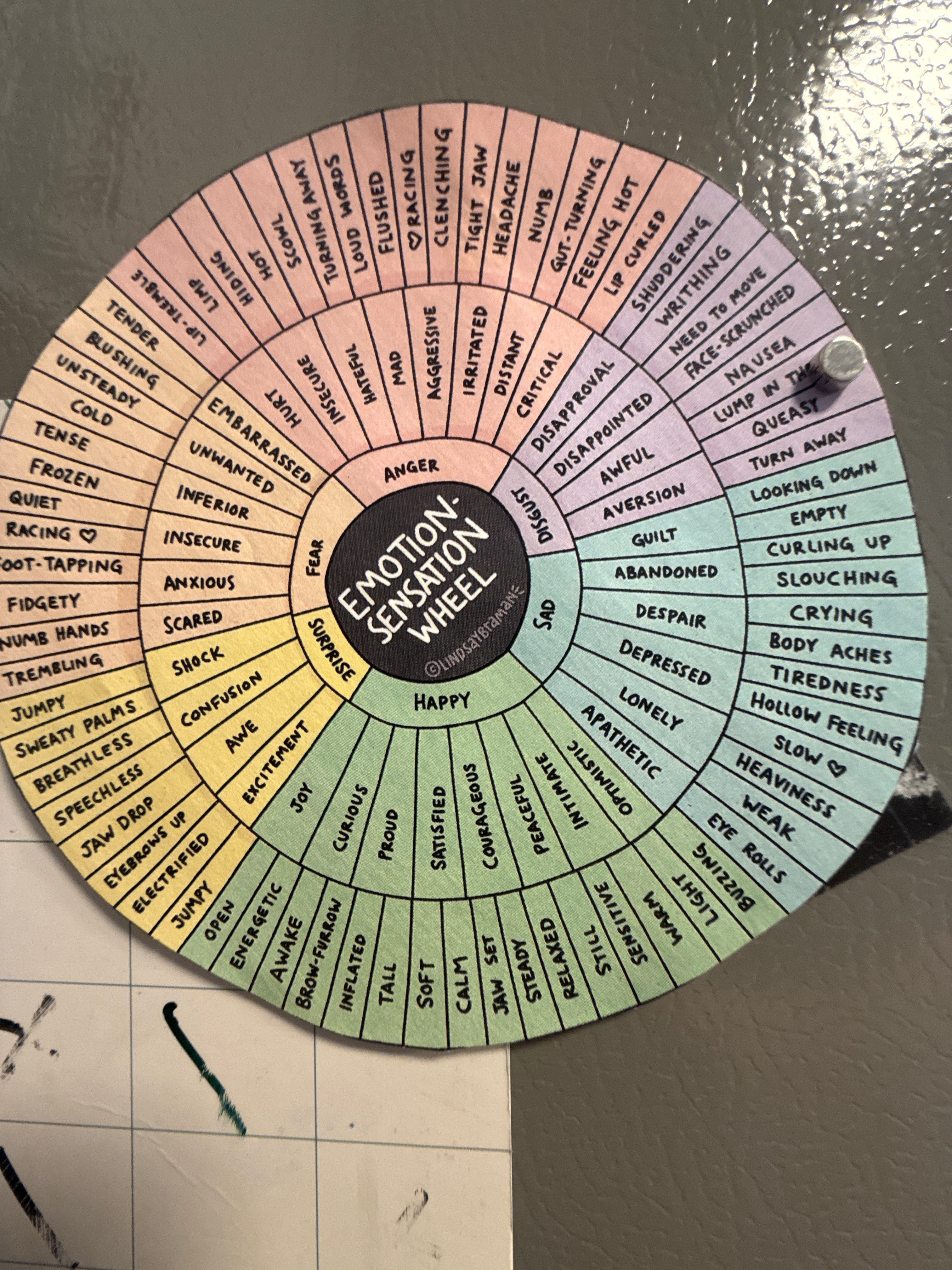
Whether it is a book, podcast, this Substack, or a simple chart, each new tool help you do the work of coming home to yourself.
This is the work of coming home to yourself. It is the slow, sacred process of learning to trust your own mind and body again, of finding the words that match the knowing in your bones.
It wasn’t your fault that you were lost in the fog.
Your experience is real. Your perception is trustworthy.
Your dignity matters — always.
i loved listening to your voice! this popped up on my feed, and i had a moment to listen. i was excited to close my eyes before bed and let the words wash over me. you have a very soothing voice, full of truth and wisdom. and i love the messages you brought to light. so glad we’re here together! 🙏
Yes! Great essay on this specific aspect of spiritual abuse. ❤️🩹 This was definitely true of my experience, and I’m glad to have a new term for it: “hermeneutical injustice.” That makes so much sense!!